Top 15+ Web Development Projects (2026)
By Arjun Mathur
Updated on Jul 29, 2026 | 25 min read | 774.74K+ views
Share:

All courses
Certifications
More
By Arjun Mathur
Updated on Jul 29, 2026 | 25 min read | 774.74K+ views
Share:
Table of Contents
Quick Overview:
In this blog, we’ll explore the best web development projects for beginners and final-year students in 2026.
Launch your AI career with upGrad's Artificial Intelligence courses. Learn machine learning, deep learning, NLP, computer vision, generative AI, and agentic AI through industry-focused projects, expert mentorship, and hands-on learning.
Popular Data Science Programs
The most effective way to master coding is by building real applications. Whether you are looking for simple website project ideas for students to pass a semester or laying the groundwork for a career, this list covers the essentials.
Below, we explore nine foundational web development projects that range from static designs to dynamic, API-driven applications.
A personal portfolio is the cornerstone of all web development project ideas. It acts as your digital resume, giving you a platform to display your biography, technical skills, and links to your GitHub repositories.
Unlike generic templates, building a portfolio from scratch allows you to practice semantic HTML and responsive CSS. It is the first entry every recruiter looks for when evaluating project ideas for web development portfolios.
Also Read: Computer Science Project Ideas
Creating a high-converting landing page is a highly employable skill. This project involves cloning the layout of popular product pages (like Netflix or Spotify), making it one of the most practical web development projects for understanding UI/UX.
The goal is "Pixel Perfection", ensuring the site looks flawless on mobile and desktop. Mastering this project prepares you for the complexity found in advanced projects later in your career.
If you are looking for web development project ideas that move beyond static content, a JavaScript Quiz App is the perfect next step. This application tracks user scores and displays results dynamically without refreshing the page.
It introduces the concept of "State Management," a critical skill. While it is simpler than the web development projects ideas for final year students, it uses the exact same logic (DOM manipulation) found in large-scale enterprise apps.
Also Read: Computer Science Project Ideas
The To-Do List is arguably the most famous of all web development projects. It teaches you the "CRUD" operations (Create, Read, Update, Delete) that power almost every major software application in existence.
This project ensures you understand how data flows in an application. If you are brainstorming website project ideas for students that are easy to explain in an interview but technically sound, this is your best option.
Before you begin to build, understand how sites are managed and updated. Learn the basics in our guide on CMS Full Form.
Building a blog is a comprehensive exercise. It is one of the more robust project ideas for web development because it forces you to tackle user authentication (logins) and content management systems (CMS).
This project bridges the gap between frontend and backend. Successfully completing a blogging platform demonstrates that you are ready to tackle larger projects involving database schemas and server-side routing.
Modern web development is defined by connectivity. The Weather App is a staple among web development project ideas because it teaches you how to fetch live data from third-party sources (APIs) and display it to the user.
By handling JSON responses and updating the UI asynchronously, you gain skills that are directly applicable to the industry. It remains one of the most popular web development project ideas for mastering fetch and async/await.
Read More: Best Python Project Ideas & Topics
Learning doesn't always have to be serious. The Meme Generator is a creative entry in our list of web development projects. It allows users to upload images, overlay text, and download the result.
This project focuses on the HTML5 Canvas API, proving that project ideas for web development can be graphical and interactive, not just text-based. It’s a fun way to sharpen your JavaScript logic.
The Recipe Finder App allows users to search for meals by ingredients. It is a fantastic exercise for learning how to filter lists and handle complex data arrays, which is a common requirement in commercial web development project ideas.
As far as website project ideas for students go, this one is excellent for practicing search algorithms. You will learn to take user input, query an API, and format the results into a clean, responsive grid.
Related Article: HTML Project Ideas for Beginners
Building a Music Playlist Website challenges you to handle media within a browser. This project requires you to manage audio playback, pause states, and track progress, making it one of the more engaging web development project ideas.
Visualizing audio and managing the "state" of the player makes this a standout addition to your portfolio. It shows you can build web development projects that offer a rich, multimedia user experience.
Dive Deeper: Android Projects With Source Code
Free Courses
Once you have mastered the basics, it is time to tackle more complex challenges. The following projects are designed for learners who are ready to handle databases, user authentication, and API integrations.
Mastering these project ideas for web development is the crucial bridge between simple scripts and the advanced web development projects ideas for final year students that recruiters expect to see.
Building a social media app is one of the most challenging yet rewarding project. It covers the full spectrum of development, from secure user authentication to handling real-time feeds.
Unlike smaller website project ideas for students, this application requires a scalable architecture. It proves you can manage complex relationships between data (users, posts, comments, and likes).
Also Read: Top Hackathon Ideas
An E-commerce platform is a staple in the industry and one of the most employable web development projects you can build. It involves product management, shopping carts, and integrating secure payment gateways.
This project is often considered the "gold standard" for intermediate learners. If you can build this, you are well on your way to tackling professional web development project ideas in a corporate environment.
Must Read: Django Open-Source Projects to Build in 2026 With Code!
An LMS helps students and teachers manage online courses and track progress. It is a fantastic web development project for understanding user roles, specifically, how to show different interfaces to an "Admin" versus a "Student."
As far as project ideas for web development go, this one is highly practical. It simulates real-world educational tools and teaches you to handle secure logins and data reporting.
Related Article: How to Create a Dynamic Web Project Using Eclipse
Integrating Artificial Intelligence is the next frontier. This project involves building a web interface that communicates with an AI model to answer user queries. It is one of the most impressive project for a resume.
While many web development projects ideas for final year students focus solely on code, this project shows you can integrate emerging tech like Natural Language Processing (NLP).
Data visualization is a massive skill gap in the market. A Sentiment Analysis Dashboard takes customer feedback (text) and analyzes it to display trends (Positive vs. Negative) on a chart.
This is one of those web development projects that proves you aren't just a coder, but a data-savvy developer. It combines backend logic with beautiful frontend visualizations.
Also Read: 30 Exciting JavaScript Projects for Beginners in 2026
Data Science Courses to upskill
Explore Data Science Courses for Career Progression
IIIT Bangalore
Executive Post Graduate Certificate in Data Science & AIPlacement Assistance
When you reach your final semester, the expectations change. Academic assignments are no longer enough; you need projects that mimic real-world software used by industries.
The following list contains advanced web development project ideas for final year submissions. These projects integrate AI, complex database relations, and real-time communication to prove you are ready for the workforce.
This system allows patients to book appointments while doctors manage schedules efficiently. It is one of the most socially relevant projects you can build.
To make this unique among other project ideas for web development, you can integrate an AI component that predicts appointment durations or sends automated reminders. It demonstrates your ability to build secure, HIPAA-compliant-style applications.
A Job Portal connects recruiters with candidates, serving as a classic example of a two-sided marketplace. It is one of the most practical projects with source code available for study, yet building it from scratch is a massive achievement.
This project requires you to handle complex filtering (searching jobs by location, salary, and role), making it one of the best web development projects to master database queries and search indexing.
Advance your AI career with the Executive Post Graduate Certificate in AI-Native Software Engineering from IIT Kharagpur. Learn AI-native software development, LLMs, agentic AI, RAG, and modern engineering practices through hands-on projects and industry-focused training.
Planning and booking events require a system that handles dates, payments, and seat availability simultaneously. This project mimics real-world SaaS (Software as a Service) applications, making it a standout entry in any list of development projects.
Recruiters appreciate this project because it involves "CRUD" on steroids—complex relationships between Venues, Events, and Attendees. It is one of the solid web development projects ideas for final year students who want to become backend specialists.
Inspired by Google Docs, this application allows multiple users to edit a document simultaneously. It is arguably one of the most technically difficult web development projects on this list.
This project moves beyond standard HTTP requests and uses WebSockets for instant data syncing. Successfully building this places you in the top tier of candidates, as it is one of the most advanced projects a student can attempt.
A Fitness Tracker allows users to log workouts, track calories, and visualize their progress over time. It is an excellent web development project for intermediate learners because it focuses heavily on "Create" and "Read" operations with date-based filtering.
Among web development project ideas, this one is personal and engaging. It challenges you to build a dashboard that updates dynamically as the user inputs new data, bridging the gap between a simple utility and a full-featured app.
Also Read: What Is Data Science? Courses, Basics, Frameworks & Careers
Before diving into your next project, it’s important to understand the difference between academic projects you generally do during coursework and industry-relevant projects that make your portfolio stand out.
Feature / Aspect |
Academic Projects |
Industry-Relevant Projects |
| Scope | Limited to course requirements or assignments | Real-world problems, full-stack solutions |
| Complexity | Beginner to intermediate | Intermediate to advanced, often full-stack |
| Tech Stack | Basic HTML, CSS, JavaScript, maybe simple backend | Modern frameworks, APIs, databases, cloud services |
| Deployment | Often local or class submission | Hosted online (Netlify, Vercel, AWS, GitHub Pages) |
| Learning Outcome | Understand fundamentals | Practical skills, portfolio-ready projects |
| Portfolio / Resume Value | Low to medium | High, improves job or internship prospects |
| Collaboration / Team Work | Usually individual | Often involves teamwork, version control (GitHub) |
| Career Relevance | Limited | Highly relevant for jobs and internships |
Adding real-world projects to your resume helps recruiters evaluate your practical coding and problem-solving skills. The projects below are highly recommended for building a strong developer portfolio and improving placement opportunities in 2026.
Project |
Best For |
Key Skills |
| E-commerce Platform | Full-Stack Development | APIs, Payments, Databases |
| AI Chatbot Web App | AI Integration | NLP, APIs, Python |
| Real-Time Collaboration Tool | Advanced Projects | WebSockets, Firebase |
| Social Media Application | Backend + Frontend Skills | Authentication, Feeds |
| Learning Management System (LMS) | Dashboard Development | CRUD, User Roles |
| Blogging Platform | Backend Development | CMS, Databases |
| Job Portal Website | Placement Portfolio | Search Filters, APIs |
| Weather App | Intermediate Learners | API Fetching, JavaScript |
| Fitness Tracker App | Data Visualization | Charts, User Data |
| Portfolio Website | Beginners | Responsive Design, UI/UX |
Web development projects are practical applications that help you build websites and web apps while applying frontend, backend, and database concepts. They range from simple portfolio websites to advanced e-commerce platforms and dashboards, making them an excellent way to strengthen your coding skills and build a professional portfolio.
Working on web development mini projects helps beginners understand HTML, CSS, JavaScript, and basic backend development. As your skills improve, you can move on to full stack web development projects that combine user interfaces, APIs, databases, authentication, and deployment.
Choosing the right tech stack is essential for building effective web development project ideas. The tech stack determines how your project functions, how easy it is to maintain, and how well it can scale.
Beginners and final-year students can select stacks based on their project type like frontend, backend, or full-stack and even showcase their work as GitHub projects.
The frontend is what users see and interact with. Choosing the right tools helps make your projects visually appealing and user-friendly.
The backend powers your project’s functionality, data processing, and server logic.
Also Read: Career in Data Science: Jobs, Salary, and Skills Required
Storing data efficiently and deploying your projects online is critical for real-world applications.
A structured development process helps you build reliable web applications from idea to deployment. Whether you're working on web development projects for students or advanced full stack web development projects, following the right workflow improves code quality, scalability, and maintainability.
A typical web development project follows these stages:
Following this workflow makes it easier to complete everything from web development mini projects to web development projects ideas for final year in an organized manner.
As web technologies continue to evolve, companies are looking for developers who can build fast, scalable, and AI-powered applications. Learning the right technical skills not only improves your employability but also helps you build industry-relevant web development projects for internships and placements.
The table below highlights some of the most in-demand web development skills in 2026 and their practical applications in modern software development.
Skill |
Why It’s Important |
Common Use Cases |
| React.js | Builds fast, interactive user interfaces | Frontend Web Apps |
| TypeScript | Improves code quality and scalability | Large-Scale Applications |
| Node.js | Enables backend development using JavaScript | APIs, Full-Stack Apps |
| REST APIs | Connects frontend and backend systems | Data Fetching, Integrations |
| AI Integration | Adds intelligent features to applications | AI Chatbots, Recommendations |
| Cloud Deployment | Helps host and scale applications online | AWS, Vercel, Netlify |
| Database Management | Stores and manages application data | MongoDB, PostgreSQL |
| Git & GitHub | Essential for collaboration and version control | Team Projects, Portfolios |
| Responsive Design | Ensures mobile-friendly user experiences | Cross-Device Compatibility |
| Authentication & Security | Protects user data and applications | Login Systems, Secure Apps |
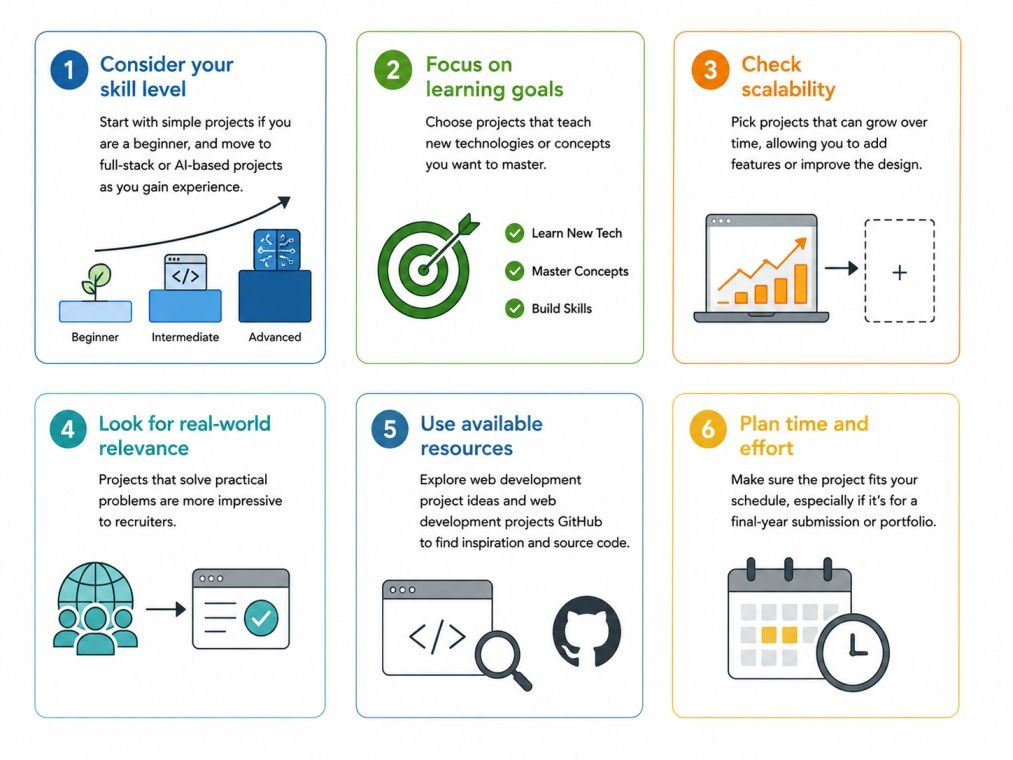
Selecting the right web development projects is important for learning effectively and building a strong portfolio. The right project matches your current skills, challenges you enough to grow, and can be showcased as GitHub development projects.
Beginners and final-year students should consider factors like complexity, tech stack, and real-world relevance before starting.
Tips for Choosing the Right Web Development Project:
Also Read: Data Science vs Data Analytics: What are the Differences?
When working on web development projects, beginners and final-year students often make mistakes that can slow down learning or reduce the project’s impact. Avoiding these pitfalls ensures your projects are effective, well-organized, and portfolio-ready.
Key Mistakes to Avoid :
Also Read: Data Science Specializations in India 2026
As you explore web development projects for students, you'll come across different project categories based on skills and objectives. Understanding these differences helps you choose the right project for learning, portfolio building, or academic work.
Both project types help you improve web development skills, but they focus on different parts of an application.
| Feature | Frontend Projects | Full Stack Web Development Projects |
|---|---|---|
| Focus | User interface and user experience | Complete web application |
| Technologies | HTML, CSS, JavaScript, React | Frontend, backend, database, APIs |
| Database | Not required | Required |
| Server-side Logic | No | Yes |
| Authentication | Limited | Fully supported |
| Best For | Beginners and UI practice | Real-world applications and portfolios |
Although the terms are often used together, web development and web design focus on different aspects of building websites. Many web development mini projects involve coding, while web design projects concentrate on visual appearance and user experience.
| Feature | Web Development Projects | Web Design Projects |
|---|---|---|
| Primary Goal | Build functional websites and applications | Create visual layouts and user experiences |
| Main Skills | Programming and backend logic | UI, UX, typography, and color design |
| Common Tools | HTML, CSS, JavaScript, React, Node.js | Figma, Adobe XD, Photoshop |
| Output | Interactive web applications | Design prototypes and mockups |
| Suitable For | Developers | UI/UX Designers |
Subscribe to upGrad's Newsletter
Join thousands of learners who receive useful tips
Building hands-on web development projects is the best way to learn, gain confidence, and create a strong portfolio that stands out to recruiters. From beginner-friendly projects like personal portfolios and to-do apps to advanced final-year projects like AI chatbots and e-commerce platforms, each project helps you develop practical coding, problem-solving, and real-world application skills.
If you want to accelerate your journey, enrolling in our industry-leading Data Science Courses can give you structured learning, mentorship, and exposure to the latest tech stacks.
Ready to take the next step in your career? Book a free counselling session today to understand which course suits your goals, get guidance on project selections, and start building your professional web development journey.
Similar Reads:
Web development projects serve as practical proof of your coding abilities, often weighing more than certifications during recruitment. They demonstrate your problem-solving skills and familiarity with the software development lifecycle, allowing hiring managers to assess your capability to build real-world applications rather than just understanding theoretical concepts.
You should select a project that introduces one new major concept while leveraging your existing skills. Beginners should focus on static sites to master layout, while intermediate learners should attempt dynamic applications. Advanced candidates need to build full-stack systems to demonstrate proficiency in databases, APIs, and authentication.
The most effective projects for absolute beginners rely on HTML, CSS, and basic JavaScript to build foundational confidence. Excellent starting points include a personal portfolio website to showcase your resume, a landing page clone to practice CSS layouts, or a simple To-Do List app to understand basic logic.
You do not need backend skills to start building meaningful applications. You can create highly functional frontend projects using only HTML, CSS, and JavaScript that focus on User Interface and Experience. However, creating complex platforms like e-commerce stores eventually requires backend knowledge like Node.js or Python.
Mini-projects are ideal for quick learning sessions or hackathons. Great examples include a Weather App fetching real-time data via APIs, a Calculator for practicing logical operations, or a Random Quote Generator. These projects are small in scope but effective for mastering specific concepts like DOM manipulation and API fetching.
Frontend projects must visually impress the user and demonstrate responsive design. Strong ideas include a Movie Search App using the OMDB API, a responsive E-commerce Product Page with an image gallery, or a Music Player interface. These projects highlight your ability to craft engaging and functional user interfaces.
Full-stack projects prove your ability to handle both client-side and server-side architecture. You can build a Blogging Platform where users register and write posts, a real-time Chat Application using WebSockets, or a Task Management System like Trello. These require connecting a database, backend logic, and a frontend interface.
For a final year project, stick to industry-standard technology stacks to ensure employability. The MERN stack (MongoDB, Express, React, Node.js) is highly popular for startups, while the LAMP stack remains a classic choice. Python with Django is also excellent if your project involves data analysis or artificial intelligence integration.
To stand out in your final year, combine web development with emerging technologies like AI or Blockchain. Consider building an AI-Powered Resume Screener that rates uploaded documents, a Blockchain Voting System using smart contracts, or a Telemedicine Portal connecting patients with doctors via video calls and appointment booking features.
The timeline depends on the complexity of the application. Simple mini-projects usually take a weekend or about 10 hours. Standard frontend projects might require one to two weeks. However, a comprehensive full-stack or capstone project generally takes four to eight weeks to design, code, test, and deploy effectively.
Both approaches offer distinct career advantages. Solo projects demonstrate your ability to independently manage the entire development stack. Conversely, group projects are excellent for interview discussions as they allow you to highlight essential soft skills like collaboration, version control usage with Git, and conflict resolution within a team.
You can locate high-quality open-source code on platforms like GitHub, CodePen for frontend visuals, and FreeCodeCamp. However, you should never simply copy code for a final project. Instead, use these resources to understand the underlying logic and architecture, then rebuild the application yourself to ensure full comprehension.
Recruiters prioritize projects that show complexity and business utility. The most impactful additions are a fully functional E-commerce Application handling payments, a Social Media Dashboard displaying data visualization, or a Project Management Tool. These demonstrate your ability to manage databases, user authentication, and complex Create-Read-Update-Delete (CRUD) operations.
Quality is far more important than quantity when building your portfolio. You should aim to include three to five high-quality projects. It is significantly better to showcase three fully functional, deployed, and bug-free applications than to list ten half-finished tutorials that do not demonstrate professional competency.
Yes, deployment is absolutely critical because recruiters rarely download code to run it locally. You must host your projects on free platforms like Netlify or Vercel for frontend apps, or Render for backend services. A live link proves your work is production-ready and allows instant verification of your skills.
Structure your explanation using the STAR method: Situation, Task, Action, and Result. Briefly describe the problem you wanted to solve, the specific goal you had, the technologies and logic you implemented to build the solution, and the final outcome or efficiency gained by the application you created.
A Progressive Web App (PWA) is a website that offers a native mobile app-like experience. Building a PWA, such as an offline news reader, is an impressive portfolio addition because it demonstrates your advanced understanding of modern web standards, service workers, caching strategies, and mobile-first design principles.
A well-structured project is easier to build, test, and maintain. Start by separating the frontend, backend, database, and assets into organized folders. This approach works well for web development mini projects and scales naturally to full stack web development projects, making your code cleaner and easier to understand for both collaborators and recruiters.
A clone project replicates an existing app like Netflix to practice skills, while a unique project solves a specific user problem. While clones are great for learning, unique projects usually score higher in portfolios because they demonstrate product thinking, creativity, and the ability to engineer original solutions.
Technology evolves rapidly, so you should review your portfolio every six months. If you built a project years ago using an outdated framework version, refactoring the code to the latest standard is wise. This proves to recruiters that you are proactive and stay current with industry trends.
59 articles published
Arjun Mathur is Program Marketing Manager for the Software Development, bringing over 5+ years of experience in ed‑tech and growth marketing. A B.Tech in Computer Engineering from IIT Delhi, he specia...
Speak with Data Science Expert
By submitting, I accept the T&C and
Privacy Policy
Start Your Career in Data Science Today
Top Resources
Executive Diploma
12 Months
Master's Degree
18 Months
Bootcamp
6 Months